Is our information ecosystem still robust? Notes from a parliamentary hearing
On 20 October, my ORM colleague Antonin Descampe and I had the opportunity to testify before the Media Committee of the Parliament of the Wallonia-Brussels Federation. It is an unusual exercise: you have to sum up years of research in a short time and, above all, move from diagnosis to concrete proposals. Here are the main points we presented.
Our starting point fits in one sentence: public-interest news has almost no viable business model left in French-speaking Belgium, even though a robust information ecosystem is more necessary than ever for democracy. In other words, what looks like an economic crisis for the sector is turning into a democratic one.
A small market under pressure
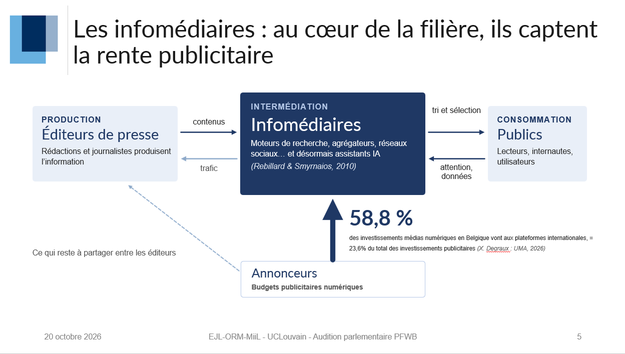
The first problem is structural. Over the past thirty years, successive technological waves (the web, search engines, social media, mobile, and now AI) have placed infomediaries between news organisations and their audiences. These intermediaries capture attention and, with it, advertising revenue. In Belgium, 58.8% of digital advertising investment goes to international platforms (UMA, 2026). What remains must be shared among publishers in a market that, unlike France or the United States, is too small for a few titles to thrive on subscriptions: only 14% of Belgians pay for online news (Picone, 2026).
On top of this comes an unprecedented wave of concentration. Since the Rossel–IPM merger, approved with conditions on 3 July 2026, all six French-language daily newspapers are published or co-published by a single group, which amounts to 94% of the daily print press according to RSF. The landscape remains diverse if you look further (the mapping carried out by Clémence Petit and Olivier Standaert for the ORM and CRISP counts 118 periodicals and around sixty digital-native outlets), but these are often non-profit, volunteer-run or niche organisations whose survival is far from guaranteed.
Finally, we should not forget that producing news takes media groups, but also journalists. Their working conditions are deteriorating: a large share of freelancers (between 25% and 50%, depending on the estimate), many of whom work for a single outlet; an income gap of around 30% compared with salaried staff; and 71.5% who report a heavier workload in recent years (AJP, 2023; Labourie, 2024).
Audiences turning away and the growth of FIMI
On the audience side, the trends are well known but worth recalling. In Belgium, 41% of people get their news through social media (+4 points this year, a figure that keeps rising), compared with 49% through television and 18% through print newspapers (both figures falling year after year). Above all, 42% of French-speaking Belgians sometimes or often avoid the news, and only 28% trust it most of the time (Digital News Report, 2026).
These figures will come as no surprise to anyone who follows these issues, but their persistence should be more of a cause for concern. This is all the more true given the growing development of what European institutions call FIMI (Foreign Information Manipulation and Interference): coordinated and intentional operations through which foreign actors attempt to manipulate a country’s information space in order to influence democratic processes, notably elections (the EEAS documents more than 540 incidents of this type in 2025, spread across more than 10,500 different social media channels and websites (EEAS, 2026)).
AI as an accelerator
As my colleague Antonin, who specialises in this question, points out: AI does not create these weaknesses, it accelerates them. Three mechanisms seem particularly important to us:
- Greater technological dependence. The large American tech companies, which already controlled the distribution of news, now also control a growing share of the means of producing it (Simon, 2022). The printing presses were in Nivelles; the servers are in the United States.
- Media becoming invisible. Journalistic content becomes a raw material, absorbed and rephrased by AI assistants, then detached from its source. 28% of people who see an AI summary rarely or never click through to the sources (Simon, Nielsen & Fletcher, 2025), while 45% of these assistants' answers about the news contain at least one significant issue (EBU & BBC, 2025).
- The industrialisation of disinformation. It is now possible to produce anything and deliver it to anyone. The risk is not only that people believe what is false, but also that they stop believing what is true: this is known as the "liar's dividend". I see it as an extension of what I described, in an earlier post, as a form of automated doubt.
What can be done?
We argued for a robust and resilient local information ecosystem, suited to the "small market" of French-speaking Belgium. It is an economic question, but not only that. Concretely, we put forward several proposals:
- Build an evidence base. Consolidated data on journalists' employment, status and income, or on the effectiveness of public support, are sorely lacking. A governance tool for public media policy would make it possible to track how these evolve.
- Rethink (and increase) funding, with support differentiated between small organisations and large groups, and a responsible approach to the decline of print.
- Stabilise revenues, by making subscriptions easier and redirecting public-sector advertising towards local players.
- Encourage "coopetition": pool certain infrastructure (AI tools, distribution platforms) and negotiate collectively with AI companies. Public service media could act as robustness infrastructure rather than as a mere competitor.
- Protect the profession, in particular by tackling bogus self-employment, making public support conditional on employment standards, and changing how journalists' copyright income is taxed.
- Educate audiences in media and algorithmic literacy.
- Genuinely enforce the European framework (EMFA, DSA, DMA, AI Act). Its impact will depend less on its adoption than on the investigative powers and data access that come with its implementation.
None of these measures will be enough on its own, and they fall under different levels of government (the Wallonia-Brussels Federation, the Regions, the federal state, the European Union). This may be the main difficulty (as is often the case in Belgium): the problem is systemic, while the levers are scattered.
What next?
This is not the first time researchers have raised the alarm on these issues, and it will not be the last. But we feel that this moment is different: press concentration, the announced end of certain subsidies and the massive arrival of AI in the news production chain are all happening within a very short time.
This is also why we are preparing, at the ORM, a public website that will bring together the results of our surveys on news practices, distrust of the media, newsroom diversity and the mapping of the press in French-speaking Belgium. I will come back to it here soon.
In short: a robust information ecosystem does not maintain itself; it has to be built, and that requires urgent and coordinated public action.
The slides from the hearing and the full list of references are available on request.
Main references: Digital News Report 2026 (Reuters Institute); Petit & Standaert, Cartographie des médias d'information en Belgique francophone (CRISP, 2025); RSF (2026); UMA, via X. Degraux (2026); EBU & BBC, News Integrity in AI Assistants (2025); Simon, Nielsen & Fletcher, Generative AI and News Report (2025).
#media #journalism #AI #democracy #Belgium
Updated on October 26, 2026.